
In-Home Lactation Consultant in Fort Worth & DFW: What a Home Visit Looks Like
Monday, November 09, 2026
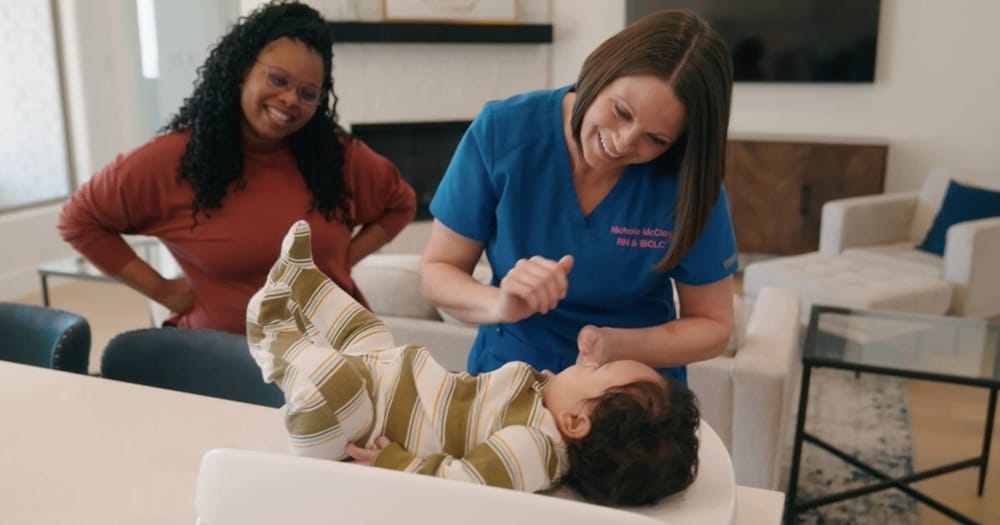
By Nichole McCloy, RN, IBCLC · Labor & delivery nurse since 2004 · IBCLC since 2015 · Founder, Fort Worth Lactation & Tongue Tie SpecialistsReviewed by Nichole McCloy, RN, IBCLC · Updated November 2026
The short answer: an in-home lactation visit means an IBCLC comes to your house, watches your baby eat where you actually feed, and weighs baby before and after that feed so we know how much milk baby really took in. (If a consultant doesn't bring a scale, that's a red flag.) At Fort Worth Lactation, a first visit usually runs 60 to 90 minutes, and you should always have at least one follow-up. Insurance often covers the time we spend with you, but not the time we spend driving to you, so home visits usually come with a travel fee. If you want little or nothing out of pocket, an office visit is usually your best bet.
Let me guess. There's a laundry basket on the couch that's been "about to get folded" for four days. There's a pump part drying on every flat surface in the kitchen. You haven't worn real pants since the hospital, and the idea of buckling a brand-new baby into a car seat, finding parking, and sitting in a waiting room makes you want to lie down on the floor.
Good news. You might not have to go anywhere.
I have such a soft spot for home visits. When I started Fort Worth Lactation, it was just me, driving to moms' houses all over DFW. About 27,000 miles that first year. That is a LOT of couches and a LOT of nurseries. Home visits are phenomenal, and when it works for your family, it's what I highly recommend.
But I'm going to be really honest with you in this post, the way I would if you were sitting on my couch. Because there are a couple of things every mama should know before anybody walks through her front door with a nursing pillow.
Do lactation consultants come to your house?
Some do, some don't. It really depends on the practice.
Here in DFW, most of our IBCLCs offer home visits across Fort Worth, Dallas and the surrounding area, along with office visits and telehealth. We'll tell you up front what's available where you live and what it will cost you.
Who should get a home visit?
Honestly? Any mama who'd rather not load a newborn into a car seat. (So, every mama.) But a home visit is especially worth it if:
- You had a C-section. You're healing from major surgery. Climbing in and out of the car, hauling a car seat, sitting in a waiting room chair... no thank you. We'll get a pillow over that tummy while we work on positioning.
- You're in the first week or two. Day four, milk coming in, baby cluster feeding all night. Getting dressed and out the door can feel like climbing a mountain in flip-flops.
- You had twins (or more). Two car seats, two diaper bags, two babies who each have very strong opinions about when it's time to eat. Your house is where we can figure out tandem feeding with your actual pillows and your actual couch.
- Your baby was in the NICU. NICU grads often come home still learning to breastfeed, with pumping schedules, bottles, and maybe a feeding plan from the hospital. It helps a lot to sort all of that out in the place you'll actually be doing it.
- You have a toddler (or three) at home. No babysitter needed. Your toddler can supervise. They usually do.
- Feeding falls apart at home but looks "fine" at the office. Sometimes the problem is the setup. The chair. The pillow that keeps sliding. The armrest that's exactly the wrong height. We can only fix that if we see it.
- You just want privacy. Some mamas are more relaxed in their own space, and honestly, so are their babies.
Leaving the hospital can feel a little scary for this exact reason. There, help was a call button away. At home, it's just you, baby, and a very quiet house at 2 a.m. A home visit brings some of that help back to you.
Should a home-visit lactation consultant bring a baby scale?
Yes. Every single time. This one is a non-negotiable for me.
Every IBCLC who does home visits should walk in with a baby scale and do a weighted feed. That means we weigh baby right before a feed and again right after, without changing the diaper or clothes in between, and the difference tells us how much milk actually went into baby's belly.
Maybe it's because I'm an RN and my background is very clinical, but I want the data. I need to know how much milk is going in and how often baby is eating. And you cannot know how much milk is going into that baby without a weighted feed. Without it, we're just guessing.
Because babies can stay on the breast sucking and sucking and sucking for hours. It looks like they're eating. Mom thinks they're getting all kinds of milk. And sometimes they're getting very little. It's so deceptive. Some of those babies are starving, and nobody knows it, because everything looks fine.
So hear me on this one. If your lactation consultant doesn't show up with a scale, and doesn't believe weighted feeds are a real way to check on your baby, that's a red flag. Even if she's super sweet. Even if she helped you with some things. In my opinion, that's not a thorough clinical visit, and you deserve one. Find a consultant who weighs your baby.
What happens during an in-home lactation visit? (Step by step)
Every visit is a little different, because every mom and baby are different. But here's what you can expect with us.
Before we come
- You tap your insurance on our homepage and fill out one secure form from your phone.
- We check your benefits and email you within 24 hours, often much sooner, with what's covered, whether a travel fee applies, and your options (home, office or telehealth).
- We get you on the calendar, usually within days.
When we get there
- We talk. How was birth? How's feeding going, from your side? What's hurting, what's worrying you, what are your goals? Breastfeeding, pumping, bottles, combo. Your goals lead.
- We look at your history. Baby's weights from the hospital and pediatrician, diapers, any jaundice, any supplements, any medications.
- We check on you. Your breasts and nipples, how you're healing, how you're feeling. Yes, you. You count too.
- We check baby. A full look at baby's mouth and oral function: how the tongue moves, how baby sucks, lips, palate. This is where we look for signs of a tongue or lip tie.
- We weigh baby. Before the feed, on our baby scale.
- We watch your baby eat. This is the heart of the visit. You feed like you normally do, and then we tweak. Positioning, latch, getting baby lined up and snuggled in close. Lots of hands-on help, at your pace.
- We weigh baby again after the feed. That's the weighted feed, and it tells us how much milk baby actually took in. No guessing, no "well, they seem full?"
- We look at your pump if you're pumping, and check your flange fit. Wrong-size flanges are a big cause of sore nipples and low output. The size in the box is a starting point, not a promise.
- We make your plan. Written down, simple, and doable at 3 a.m. when your brain is mostly oatmeal. How often to feed, whether to pump, how much to supplement if baby needs it (and how to do it without losing supply), and what to watch for.
- We book your follow-up before we leave. Every time. More on that below, because it's a big one.
If you want more on the visit itself, here's what happens at a lactation consultant visit.
How long is an in-home lactation visit?
At our practice, a first visit (the initial consult) usually takes 60 to 90 minutes. Follow-up visits are usually 45 to 60 minutes, depending on what's needed. We don't rush you.
Do I really need a follow-up after a lactation visit?
Yes. One-and-done visits are not a thing, and they should not be a thing.
Think about it this way. You wouldn't go to the ER with a broken bone, see the doctor once, and hear "Best of luck, call us if you need us," and then never see anybody ever again. Of course not. Somebody checks to see if it's healing.
Lactation is the same. We should be following up until things are completely resolved, and you cannot resolve everything in one visit. It's just not possible. We can help a lot in one visit. We can guide you to a better fit and a better plan and make things so much better. But fix everything in one visit? Impossible.
And even if everything is amazing after that first visit (which we love!), we still want a minimum of one follow-up to weigh baby one more time and make sure we're on our growth curve and everything is going fabulous. There are always questions that come up.
So if your lactation consultant leaves without booking a follow-up with you, you book one.
The telehealth check-in. When your insurance covers it, we'll often do a quick telehealth check-in a day or two after we see you. Because we want to know in real time: did what we taught you help, or are you still struggling? Babies change every single day, and things evolve every single day. The last thing we want is to hand you a plan that isn't working and have you suffer through it until we see you again. If it's not working, we change the plan. All you need is your phone and a quiet-ish corner. (Quiet-ish. We know.)
(Wondering how to tell how things are going at home in between? Here's how to know baby is getting enough breast milk.)
How do I prepare for a lactation consultant home visit?
Here's my very favorite part. Do not clean your house. I mean it. Put the vacuum down. We are not looking at your floors, your dishes, or the tower of Amazon boxes by the door. We've seen it all, and we're there for you and baby. If you've got a spare ten minutes before we come, take a shower or eat a snack. That's a much better use of them.
What actually helps:
- [ ] Try to time it so baby is ready to eat. If baby just ate, that's okay, we'll wait. But a hungry-ish baby is our favorite kind, because we want to do that weighted feed.
- [ ] Set up where you usually feed. Your chair, your couch, your bed, your nursing pillow. We want to see your real setup, crumbs and all.
- [ ] Have your pump, all your flange sizes, and any bottles you're using out where we can see them.
- [ ] Grab baby's weights from the hospital and pediatrician visits (discharge papers or the pediatrician's portal).
- [ ] Have your feeding log if you're keeping one: feeds, pees, poops, any supplement amounts.
- [ ] Write your questions down. Newborn brain is real. You will forget the one thing you really wanted to ask the second we walk in. 😂
- [ ] Have any nipple shields, creams or supplements you've been using nearby.
- [ ] Ask your partner or support person to be there if they can. They're going to be the one helping at 2 a.m., so they need to hear the plan too.
- [ ] Put pets in another room if they're the jumpy, sniffy type. We love them. They love our bags.
- [ ] Wear something easy to feed in. A nursing tank or button-up is perfect.
Is an in-home lactation visit covered by insurance?
Often, the visit itself is. Under the ACA, most non-grandfathered plans have to cover breastfeeding support and counseling with no cost share when you see an in-network provider. Many commercial plans cover visits at 100%, but every plan is different.
But there's one part of this that confuses a lot of families, so let me explain it.
When your insurance says "yes, home visits are covered," what they're covering is the time we spend face-to-face with you. That's true in your home, in our office, or on a telehealth call. Face-to-face time is the covered part.
What insurance does not cover is the time it takes us to get in our car and drive to your house. And in DFW, that can easily be 30 minutes to get to you and 30 minutes to get back. So that's an hour of driving on top of however long we're in your living room. Insurance pays for the living room part. It doesn't pay for the drive.
That's why there's usually a travel fee for home visits.
Why is there a travel fee for a home lactation visit?
Because drive time is real time. We see families all over the metroplex, and sometimes families who live up to 2 hours outside of it. Think about how long we're in the car for that visit. Every hour we spend driving is an hour we could have spent seeing mamas and babies in the office. The travel fee covers that time, and we'll always tell you what it is before you book. No surprises. You have enough of those.
Here's how it usually shakes out right now. In our experience, as of November 2026. Plans change all the time; this was true when we wrote it.
- Sometimes we can waive the travel fee. It's always worth asking us.
- UnitedHealthcare and Aetna families will typically have a travel fee for home visits right now. Sometimes you'll get a consultant who lives really close to you and doesn't have to drive far, and she may waive it.
- Blue Cross Blue Shield plans that don't cover telehealth, or that cap how many visits you get, will usually have a travel fee for home visits too.
- Cigna plans, and many Blue Cross Blue Shield or Anthem plans, are currently covering unlimited visits and telehealth. That lets us do those short telehealth follow-ups with you to see how things are going.
And honestly? Depending on your plan, you may be better off just paying the travel fee and having the consultant come to you. That's a totally valid choice.
If you're hoping to use only your insurance benefits and pay nothing (or very little) out of pocket, we'd encourage you to choose an office visit. That's the simplest way to keep your cost down.
We're in network with many BCBS/Anthem, Aetna & Meritain, Cigna (through Wildflower) and UnitedHealthcare-family plans. I break all of it down, including HMO referrals and plans we can't accept, in does insurance cover a lactation consultant in Texas.
So what are my options? (Two good paths)
Home visits are wonderful. They're also a boutique, white-glove kind of care, and I want to set the right expectation: even though it's what we highly recommend, not every insurance plan covers everything that comes with it.
So really, you have two good paths, and it depends on your budget and what you want.
Path 1: Use your insurance benefits. You get real, skilled care from an IBCLC, and we'll help you get the most out of what your plan covers. Insurance-covered visits are good care. Period. Insurance does put limits on what we're able to offer, like how many visits you get, whether telehealth is covered, and the drive time. That's not us being difficult. That's just how insurance works.
Path 2: Choose an FWL Premier private-pay package. Some families would rather skip the insurance limits altogether and have care that's built completely around them. With FWL Premier, you get a lot of support that insurance doesn't necessarily cover, and the care is shaped around the kind of experience you want. Some of our families come in and say, "I want the top of the line, whatever it takes." Premier is for them.
Neither path is wrong. Some mamas want to use only what insurance covers, and we're so glad to help them. Some want everything we can give. Most of us are somewhere in between, and that's okay too. Tell us what matters to you, and we'll help you pick. You can read more about Premier in private lactation care in Fort Worth.
Where do your in-home lactation consultants go?
We come to you across Fort Worth, Dallas and the surrounding area, including Keller, Southlake, Colleyville, North Richland Hills, Saginaw, Aledo, Benbrook, Weatherford, Azle, Burleson, Cleburne, Mansfield, Arlington, Irving, Denton, Plano, Frisco, McKinney, Allen, Wylie and beyond.
If you'd rather come to us (hey, maybe you're dying to get out of the house, no judgment), our offices are in Fort Worth (Basswood Blvd.), Burleson, Cleburne, Mansfield and McKinney.
Home visit, office visit or telehealth: which is better?
They're all good. They're just good at different things.
| Home visit | Office visit | Telehealth | |
|---|---|---|---|
| Best for | The first weeks, C-section recovery, twins, NICU grads, toddlers at home | Hands-on latch work, weighted feeds, tongue tie assessments, keeping costs low | Quick check-ins a day or two after a visit, pumping plans, supply questions, going back to work |
| Hands-on help | Yes | Yes | Coaching through the screen |
| Weighted feed | Yes, always | Yes, always | You can do one with a home scale |
| Sees your real setup | Yes | No | Partly (you can show us) |
| Getting out the door | Not needed | Needed | Not needed |
| Travel fee | Usually, unless we can waive it | No | No |
| Covered by insurance | The face-to-face time, often yes. The drive time, no. | Often yes | Depends on your plan |
About that home scale: you don't need a fancy one. I have a really expensive baby scale, around fifteen hundred dollars, and honestly my little Amazon one worked just as well for weighted feeds at home.
Can I book a home visit before my baby is born?
Yes, and we love it. A prenatal visit is a great idea if feeding was hard last time, you've had breast surgery, you're expecting twins, or you just want a plan before the fog hits. Then when baby comes, you already know who to call, and you're not Googling at 2 a.m.
If you're in Fort Worth, Dallas or anywhere in DFW, we'd love to help, at your house or ours. Check your insurance here, and we'll tell you what's covered, whether a travel fee applies where you live, and which kind of visit makes the most sense for you. Prefer to call? (817) 304-0992.
Quick answers
Do lactation consultants come to your house in Fort Worth? Yes. Most Fort Worth Lactation IBCLCs offer home visits across Fort Worth, Dallas and the surrounding area. We'll tell you before you book what's available where you live and whether a travel fee applies.
Should a lactation consultant do a weighted feed at a home visit? Yes. Every home-visit IBCLC should bring a baby scale and weigh baby before and after a feed. Without it, nobody knows how much milk baby actually took in. If a consultant doesn't use a scale or doesn't believe in weighted feeds, that's a red flag.
How long is an in-home lactation visit? At Fort Worth Lactation, a first visit usually takes 60 to 90 minutes, and follow-ups usually take 45 to 60 minutes.
Do I need a follow-up lactation visit? Yes. Feeding problems can't be fully fixed in one visit. Even if everything is going great, plan on at least one follow-up to weigh baby again and check the growth curve.
Is a home lactation visit covered by insurance? Often, the face-to-face time is covered. Insurance doesn't cover the consultant's drive time, so home visits usually come with a travel fee. We can sometimes waive it, so ask.
What's the cheapest way to see a lactation consultant with insurance? An office visit. If you want to pay little or nothing out of pocket, choose an office visit, and use telehealth follow-ups if your plan covers them.
How do I prepare for a lactation consultant home visit? Don't clean. Set up where you usually feed, have your pump, flanges, bottles, baby's weights and feeding log ready, write down your questions, and try to time it near a feed.
Is there an option beyond what insurance covers? Yes. FWL Premier private-pay packages are built around your family and include support insurance doesn't necessarily cover. See fortworthlactation.com/premier10.
Want a cheat sheet to keep by the couch until we get there? Grab our free Latch Fix Guide: the 10-second rule, the before-and-after nipple check, the red flags for you and baby, and when to call us. → Get the free Latch Fix Guide
Want help at home or in the office? → [Check my insurance button → https://www.fortworthlactation.com/]
This post is for education and isn't medical advice. Insurance and travel fee details reflect our experience as of November 2026; plans change all the time. If something feels off for you or your baby, call your provider or a lactation consultant.
Sources: HRSA, Women's Preventive Services Guidelines: Breastfeeding Services and Supplies. Academy of Breastfeeding Medicine, Clinical Protocol #3: Supplementary Feedings in the Healthy Term Breastfed Neonate (2017). American Academy of Pediatrics, Breastfeeding and the Use of Human Milk (2022). Nichole McCloy, All About Breastfeeding course, The Motherhood Collection.
Blessings, Nichole

Hi, I Am Jane Doe
CEO Of Best Blog Ever
Lorem ipsum dolor sit amet, consectetur adipisicing elit. Autem dolore, alias,numquam enim ab voluptate id quam harum ducimus cupiditate similique quisquam et deserunt,recusandae.
Get Our Best Selling Product!
You just read about this...
Super excited about this product? We are, too! We just wrote this whole blog post that mentions it.
Ready to buy it? Get access to the Product here:

PAGES
SOCIAL
